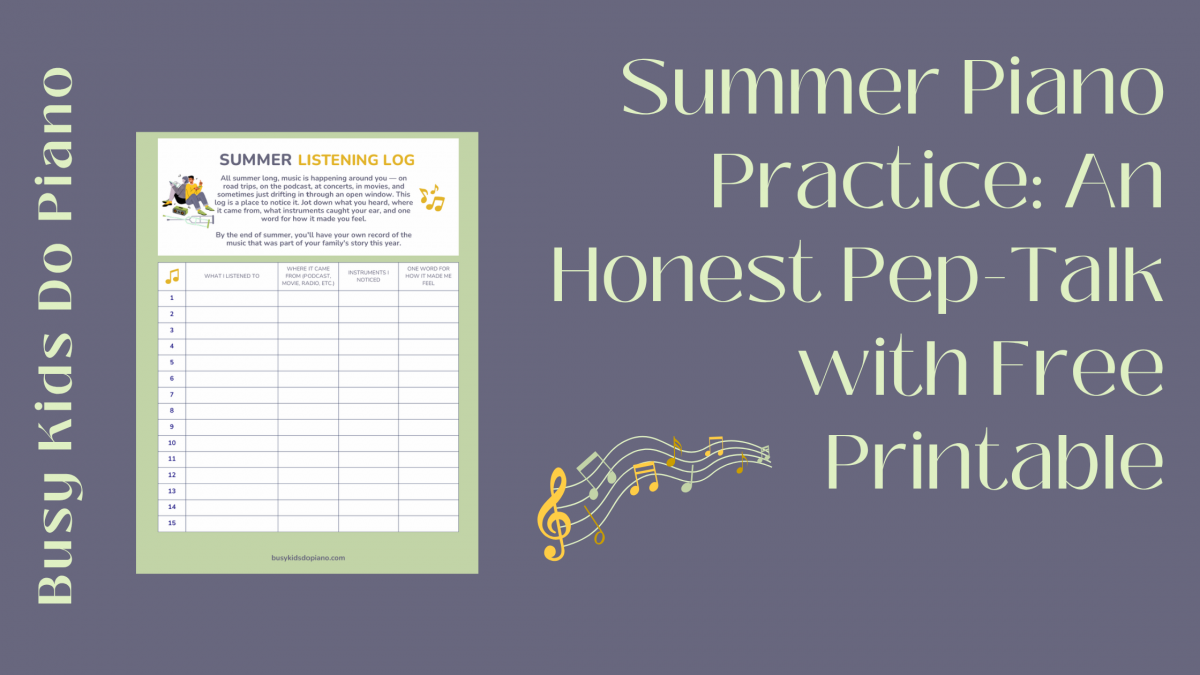
Summer Piano Practice: An Honest Pep Talk for the Moms Who Wonder If It’s Enough

Every summer, I watch something happen in our piano families. The school year ends, the schedule loosens, and somewhere around the second week of June, the question starts to creep in: are we doing enough summer piano practice?

Maybe practice has been shorter than usual. Maybe it’s been skipped a few times. Maybe your child has been playing the same piece on repeat because they love it and refuse to move on (which, honestly, is a great sign — but we can talk about that another time). And maybe you’ve been standing in the kitchen wondering if this is the summer that sets them back, undoes the progress they made, or signals that you’re not cut out for this home-teaching thing after all.

Here’s what I want to say to you, from one person who has been teaching piano for over twenty years: you are doing better than you think. And summer — real summer, with its softened routines and long evenings and absence of pressure — might actually be one of the best things that could happen to your student’s musical development.

Let me explain what I mean. Continue reading “Summer Piano Practice: An Honest Pep Talk for the Moms Who Wonder If It’s Enough”

Piano Practice Bingo Card

If your kiddo has ever looked at the piano bench like it personally wronged them, you are not alone. I’ve been teaching piano for a long time, and I can tell you with complete confidence that “practice resistance” is one of the most universal struggles in music education. It doesn’t mean your child doesn’t love music, or that you’re doing something wrong. It usually just means practice needs a little spark.

Which is exactly why I made this: a free printable Piano Practice Bingo Card.

The concept is simple, and really, that’s the point. Each square on the card has a different practice task — things like playing scales, sight-reading, improvising, working on dynamics, and more. As your student completes each task, they mark off the square. The goal? Fill a row, a column, a diagonal, or if you’ve got a particularly ambitious kid, the whole card. It’s still practice, but now it has a game layered over it, and that shift makes a surprisingly big difference.

Why it works (without feeling gimmicky)

What I love about the bingo format is that it introduces variety naturally. Your student isn’t grinding through the same checklist every day — they’re making choices, working toward a goal, and covering a truly broad range of skills along the way. Technical work like scales and tricky passages builds finger strength and coordination. Playing with dynamics helps them understand how emotion lives inside music. Improvising and experimenting with different tempos or keys builds the kind of creative confidence that sticks around long after the bingo card is done.

And if you want to add a small reward for completing a line or finishing the card? Absolutely do it. It doesn’t have to be elaborate — extra screen time, a favorite treat, a trip to get ice cream — the point is that your student has something to work toward that feels worth the effort.

How to get it

Just click the link, download the PDF, and print it out. It’s ready to use as-is, so there’s no prep work on your end. Slip it into your practice space and let your student know the game is on.

Download your free Piano Practice Bingo Card here.

If your family gives it a try, I’d love to hear how it goes — tag me on social media @busymomsdopiano. Happy practicing!

Carly

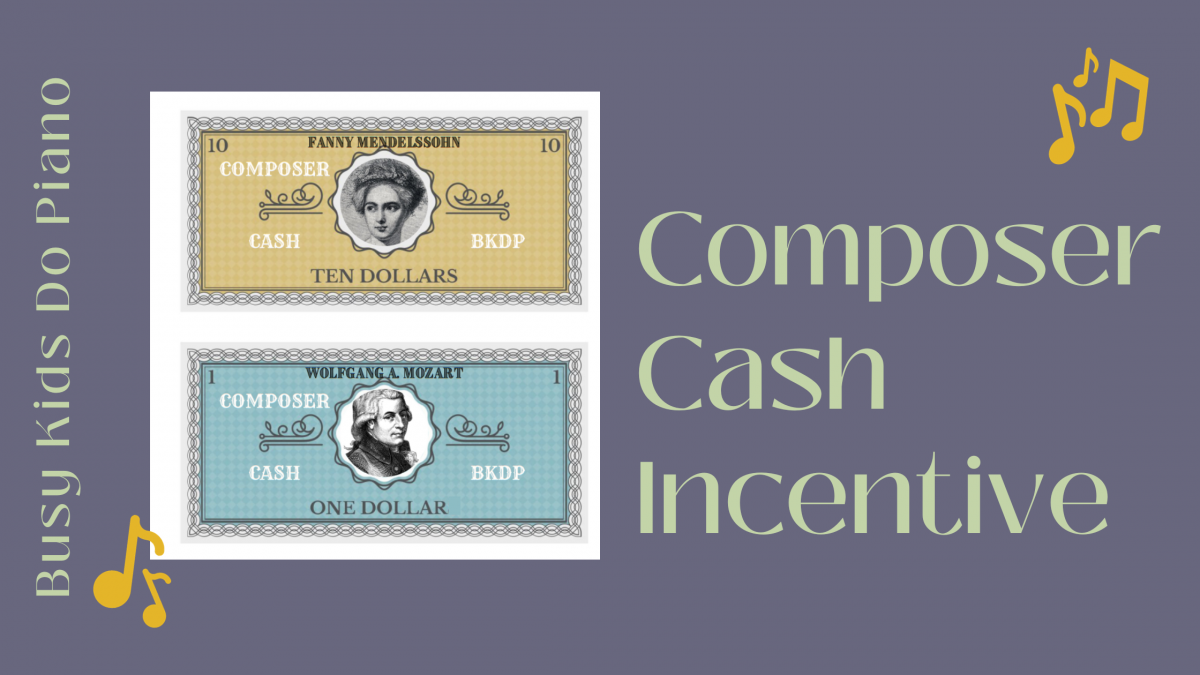
Composer Cash Incentive

There’s always something nostalgic and appealing about play-money, isn’t there? I grew up playing Monopoly and LIFE, and I remember loving a nice stack of pastel-colored cash. It felt so empowering to earn and spend my money, making grown-up types of deals with high dollar values. I bet you could tell me the color of the $500 bill in Monopoly, right? That’s how impactful these kinds of games are to us as kids! 

This month, I wanted to create that feeling for my students. The download contains printable Composer Cash, featuring a different composer on the various bills, as well as a reward chart. But the rest of the challenge is up to you, and provides a great opportunity for you to connect with your student in a meaningful way to discuss not only their piano goals, but also what kinds of incentives mean the most to them.  Continue reading “Composer Cash Incentive”

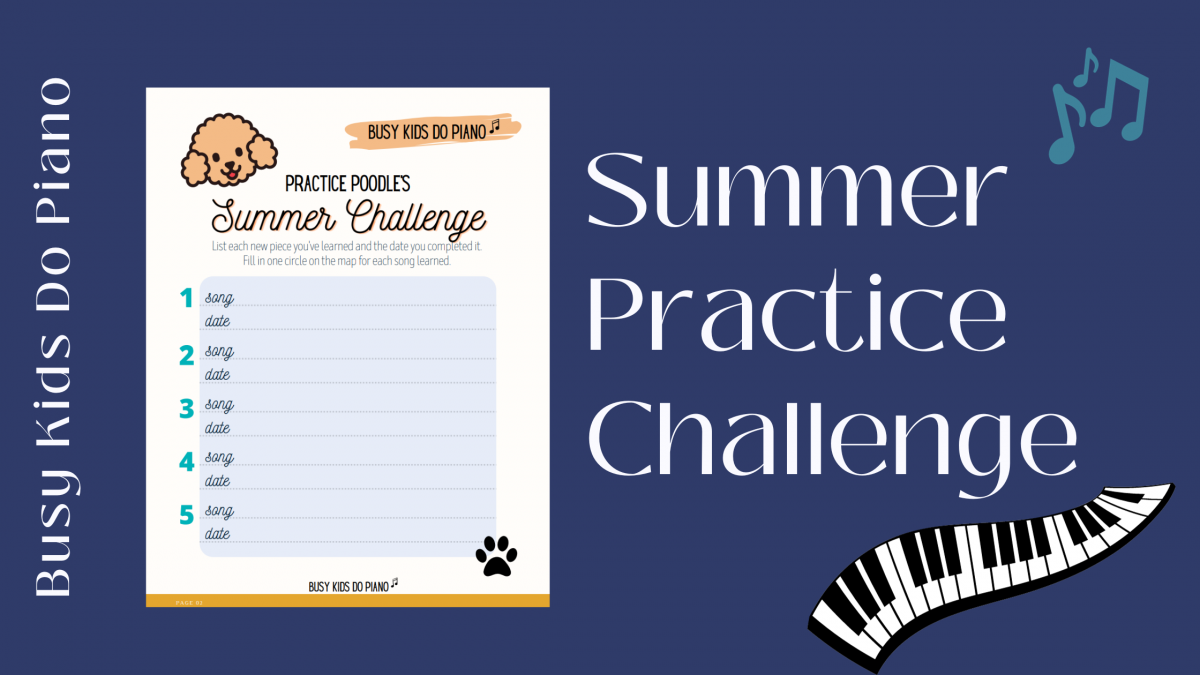
Summer Practice Challenge

Well, we are already well into the summer, and if your students are like mine, the heat, the ice cream cones, and the screen time are beginning to pull them well out of routine. It’s great to enjoy that much-needed break from the school year, but I don’t love it when my students take too much of a break from piano. Sometimes, I struggle to “inspire” them to keep practicing piano throughout the summer, and I don’t want them to lose precious ground over the break, forgetting what they’ve most recently learned. I think continually changing up the practice routine and keeping it fun can help.  Continue reading “Summer Practice Challenge”

What Should Piano Practice Include?

In the past, I’ve written about how piano practice shouldn’t be structured by requiring a specific length of practice time. A student who is required to practice for 30 minutes a day, for example, won’t necessarily make steady progress in his piano abilities.

So how, then, should a piano practice be structured? How can you ensure that piano practice will mark forward progress? Continue reading “What Should Piano Practice Include?”