
Every summer, I watch something happen in our piano families. The school year ends, the schedule loosens, and somewhere around the second week of June, the question starts to creep in: are we doing enough summer piano practice?
Maybe practice has been shorter than usual. Maybe it’s been skipped a few times. Maybe your child has been playing the same piece on repeat because they love it and refuse to move on (which, honestly, is a great sign — but we can talk about that another time). And maybe you’ve been standing in the kitchen wondering if this is the summer that sets them back, undoes the progress they made, or signals that you’re not cut out for this home-teaching thing after all.
Here’s what I want to say to you, from one person who has been teaching piano for over twenty years: you are doing better than you think. And summer — real summer, with its softened routines and long evenings and absence of pressure — might actually be one of the best things that could happen to your student’s musical development.
Let me explain what I mean.
Why Summer Is Actually Piano’s Best Season
This might sound counterintuitive, so stick with me.
During the school year, piano practice can start to feel like one more item on a very long to-do list. Get through math, get through reading, get through piano, check. And when practice feels like a checkbox, kids start to show up to the piano bench already a little resistant. They’re not wrong to feel that way — it’s just how humans respond to things that feel obligatory rather than chosen.
Summer breaks that spell. When the pressure is lower, kids often find their way back to the piano on their own terms. I’ve heard from so many families in our community who tell me that their student’s most joyful, most free-playing moments happen in July, not October. The kid who wouldn’t practice in April is suddenly noodling around after dinner because no one told them to. That’s not wasted time. That is exactly what we want music to become for them — something they reach for, not something they endure.
Think of summer like a deep breath for the musical part of your child’s brain. They’re consolidating what they learned. They’re playing things they love. They’re building the kind of relationship with the piano that will carry them through the harder seasons of learning.
That’s the long game. That’s what we’re after.
A Practice Rhythm That Doesn’t Feel Like School
Now, “lower stakes” doesn’t mean no structure at all. Total absence of routine tends to mean total absence of practice, and by mid-August you’ll be starting from scratch on a few things. The goal is a rhythm, not a schedule — something flexible enough to bend around beach days and cousins visiting and the general wonderful chaos of summer, but consistent enough that the piano stays a regular part of your week.
Here’s what works well for a lot of families during the summer months:
Keep sessions short and sweet. Ten to fifteen minutes of focused summer piano practice is honestly enough to maintain progress. You are not trying to make big gains right now. You’re tending what’s already there, like watering a plant you’ve been growing all year. Short sessions also mean less resistance at the bench, which makes them actually happen.
Let your student pick one piece to “make their own.” This is one of my favorite summer invitations to give kids. Tell them they get to choose one song from their current level (or even something slightly outside it) and really learn it — not just play through it, but own it, perform it, make it theirs. You’d be amazed how much engagement this unlocks. Kids who have been dragging their feet through their regular lessons suddenly want to practice when they chose the piece.
Drop the pressure to move forward. Summer is not the time to push through the next three levels. It’s a good time to review, polish, play favorites, and practice things that are already comfortable. Mastery is deeply underrated in a world that’s always rushing toward the next thing.
If you’re inside Busy Kids Do Piano, the structured lessons aren’t going anywhere — they’ll be right there in September. So feel free to slow down, revisit earlier levels, or just explore for a while. That’s not falling behind. That’s playing.
Why Listening Counts
I want to spend a minute on something that doesn’t always get counted as “practice” but absolutely should: intentional music listening.
This summer, we’ve been doing an “Around the World” podcast series on Busy Kids Love Music, exploring folk music from places like Puerto Rico, Norway, Nigeria, the Czech Republic, and the Philippines. These episodes were built for family listening — short, engaging, and interesting to kids and adults alike. And I want to be really clear: listening to music, talking about what you heard, noticing the instruments, asking questions about rhythm and melody — all of that is musical education. It might even be some of the best musical education your child gets this summer, because it’s happening without any pressure at all.
Music theory gets absorbed through listening. Rhythm gets internalized through listening. A sense of style, phrasing, expression — all of it goes into the ear before it ever comes out through the hands. So if your summer involves fewer minutes at the piano bench than the school year did, but it also involves a lot of music in the car and at the dinner table and on the porch in the evenings, you are building a musical foundation in your child’s life.
That counts. Please count it.
Free Printable: Summer Listening Log
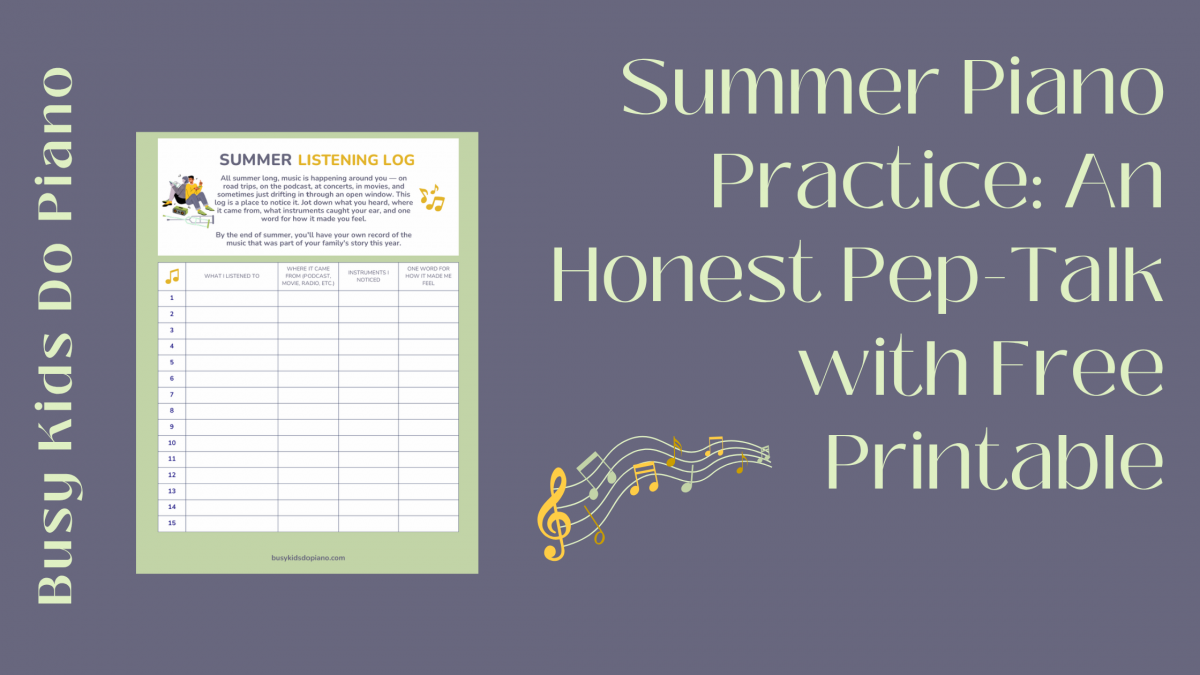
To make that intentional listening a little more tangible (and let’s be honest, kids love a chart to fill in), I’ve made a free Summer Listening Log you can download and keep on your piano or fridge all summer long.
It has space for your child to log:
- What they listened to
- Where it came from (a concert, the podcast, the radio, a movie)
- What instruments they noticed
- One word for how it made them feel
It’s simple by design. The goal is just to help your family be intentional about the music that passes through your summer — and to give your kids a way to see, at the end of August, how much music was actually in their lives.
→ Download the free Summer Listening Log here
There’s a memory I have of one summer when I took my kids to the library to sign up for the summer reading challenge. They each got a colorful chart, a little list of book suggestions, and — I’ll be honest — they were significantly motivated by the stickers and prizes. But underneath all of that, what I loved most was how the challenge gave them permission to just read. For fun. Without worrying about whether it was “enough.”
That’s what I want for piano families this summer. A little structure, a lot of freedom, and permission to count the things that truly count — even when they don’t look exactly like the school year.
You’re doing beautifully. I’m cheering you on.
—Carly
Want a full, step-by-step piano program your kids can work through all summer long — at their own pace, with you right there beside them? Busy Kids Do Piano has 360+ video lessons across 16 levels, designed specifically for families who learn at home. Come join us.