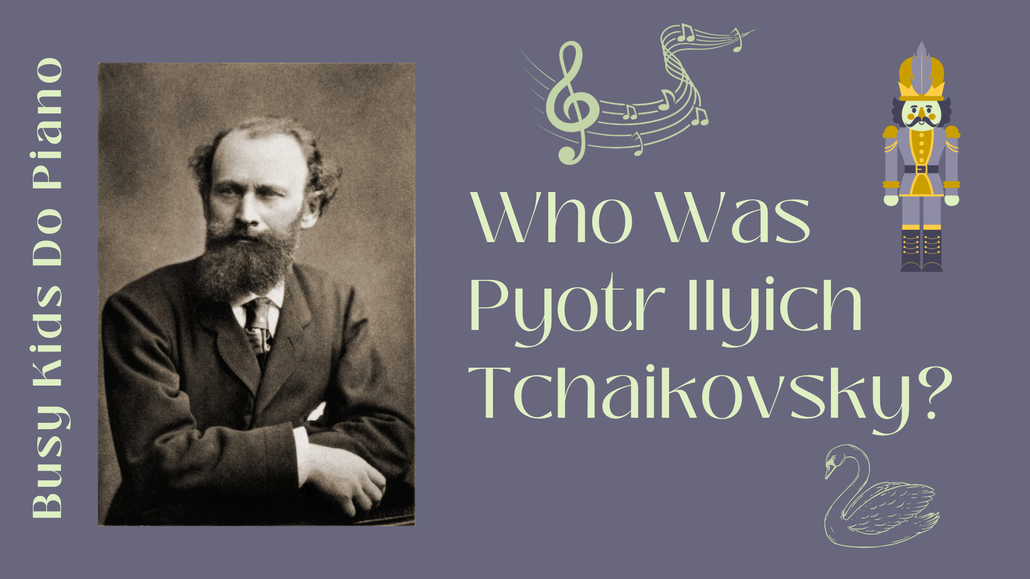
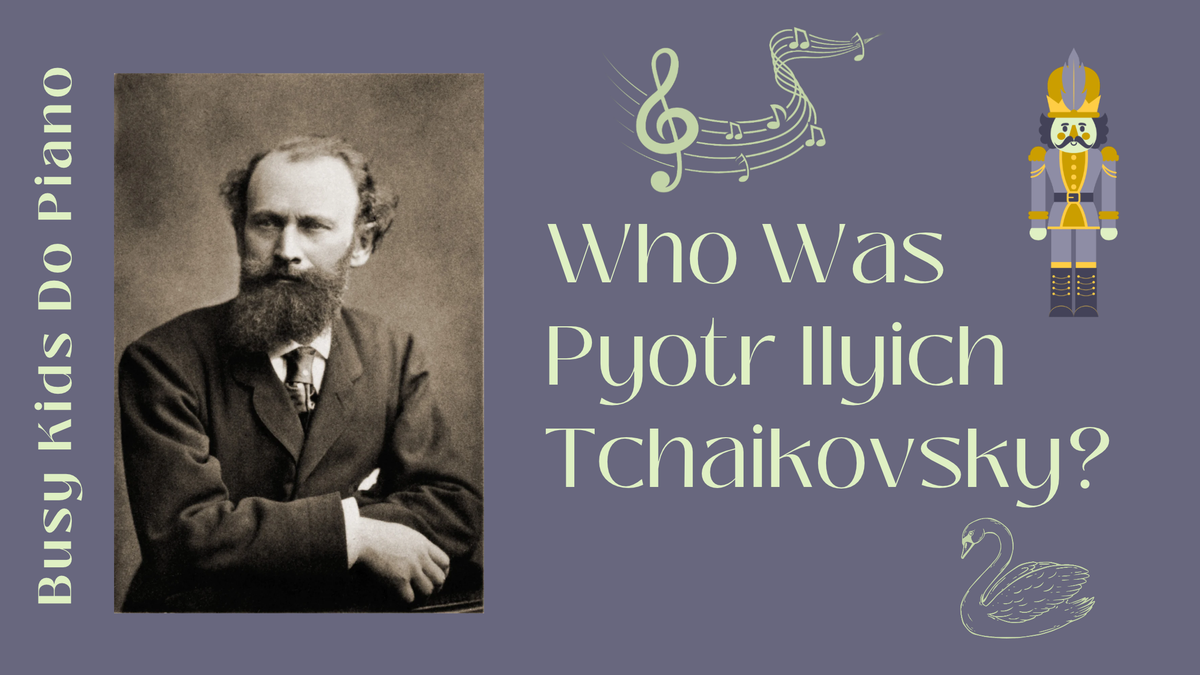
Who Was Tchaikovsky? His Life Story, Explained Simply
Here’s a little experiment for your next family dinner in December. Hum the first few notes of the Dance of the Sugar Plum Fairy and see how many people at the table can finish the tune. Then ask who wrote it. (I’d happily bet a plate of Christmas cookies that the first question gets a lot more hands than the second.)
That’s the funny thing about Pyotr Ilyich Tchaikovsky. Most of our families know his music long before they know his name. It shows up in ballet studios, holiday commercials, and Fourth of July fireworks shows (more on that in a minute). So let’s meet the man behind the melodies, because his story has a few surprising turns that I think your kids will love.
Prefer to listen? You can hear Tchaikovsky’s story told just for kids in Episode 20 of Busy Kids Love Music.
A Childhood Full of Music
Tchaikovsky was born on May 7, 1840, in Votkinsk, a small town in Russia far to the east of Moscow. His father was a mining engineer, music filled the family’s home, and young Pyotr started piano lessons when he was about five. He was a sensitive, tender-hearted boy who was especially close to his mother.
That closeness made the next chapter a hard one. When he was 10, his parents sent him to boarding school in St. Petersburg, roughly 800 miles from home, to prepare for a career in government work. Leaving his mother behind was one of the most painful moments of his childhood. (I’ll admit I can’t read that part without wanting to go hug my own kids a little tighter.)
From Government Clerk to Composer
Here’s the part I love sharing with piano families. Tchaikovsky didn’t take the straight path into music. He studied law, graduated at 19, and took a job as a clerk at the Ministry of Justice. It was a steady, sensible job, and he found it pretty dull.
So he kept music going on the side. He signed up for music classes, then enrolled at the brand-new St. Petersburg Conservatory when it opened in 1862, all while still working at the ministry. In 1863, at age 23, he finally left his government job to study music full time.
If you have a child who is a late bloomer at the piano, or if you’re a mom learning alongside your kids and wondering whether it’s too late for you (it isn’t), I hope Tchaikovsky’s story encourages you. Some of the most famous music in the world was written by a man who started out as a government clerk.
The Music the Whole World Knows
After he graduated, Tchaikovsky taught music theory at the new Moscow Conservatory and began composing in earnest. He wrote symphonies, operas, songs, and piano pieces, but a handful of works became true household names:
- Piano Concerto No. 1 (1875). Those huge, crashing piano chords at the beginning are instantly recognizable. Fun fact: it premiered in Boston, not Russia.
- Swan Lake (1877). His first ballet got a lukewarm reception at its premiere, and today it’s one of the most beloved ballets ever performed. We dig into it in Episode 22.
- The 1812 Overture (1882). Written about Russia’s defense against Napoleon’s army in 1812, it ends with real cannon fire, which is why you’ll hear it at so many fireworks shows. (Tchaikovsky himself wasn’t a fan of it, which kind of cracks me up.) Hear the whole story in Episode 21.
- The Sleeping Beauty (1890). A fairy-tale ballet full of sweeping waltzes.
- The Nutcracker (1892). The holiday ballet that so many families now treat as a December tradition. I tell the whole story for kids in Episode 9.
Ups and Downs
Tchaikovsky’s life had real highs and lows, and the hard seasons took a toll on his mental health. He went through times of deep sadness and often doubted whether his music was any good. (Anyone who has stared at a blank page or a tricky piece of music can relate to that, at least a little.)
What strikes me most is that he kept writing anyway. You can hear so much feeling in his music, with soaring joy and heavy sadness sometimes sitting right next to each other. If your kids notice that one of his pieces sounds happy and the next sounds sad, that’s a wonderful thing to talk about together, because music can hold big feelings when words can’t.
His Final Symphony
In 1893, Tchaikovsky finished his Symphony No. 6, which he called the best thing he had ever written. He conducted the premiere himself in St. Petersburg on October 28, 1893. Instead of ending with a big, triumphant finish, the symphony fades away quietly, which was very unusual at the time.
Less than a week later, he became sick, most likely with cholera from drinking water that hadn’t been boiled. He died on November 6, 1893, at age 53. (Historians still debate some of the details, so you may come across different versions, but cholera is the most widely accepted account.) The symphony became known as the “Pathétique,” and orchestras around the world still play it today.
Why Tchaikovsky Still Matters
Tchaikovsky was the first Russian composer whose music became loved all around the world, and more than 130 years later we still can’t stop humming it. His melodies are singable, his ballets tell stories kids can follow, and his music makes room for every kind of feeling. That’s what makes him such a great composer to explore as a family.
And if you’d like to compare his story with a composer whose path looked completely different, read my post on Mozart next. One was performing for royalty as a small child, and the other was a government clerk at 19 — and both ended up writing music we still love.
Listen Together: Tchaikovsky Picks for Your Family
Here are a few favorites to try this week. Pick one a day, press play while you’re making lunch, and ask your kids what they hear.
- 1812 Overture (Calgary Philharmonic Orchestra). Listen for the church bells and cannon booms near the end, and see if your kids can count them.
- Swan Lake, Act II pas de deux (The Royal Ballet). Listen for the solo violin singing the melody while the two dancers move together.
- Piano Concerto No. 1 (Alexis Weissenberg with the Berliner Philharmoniker). Listen for the giant piano chords at the very beginning while the orchestra plays the big tune.
- Sleeping Beauty Waltz (Royal Concertgebouw Orchestra). Count “1-2-3, 1-2-3” out loud and sway along, because every waltz has three beats in each measure.
- “November” from The Seasons (Bruce Liu, piano). Tchaikovsky wrote one short piano piece for each month of 1876, and this one is a sleigh ride. Listen for the jingling sleigh bells in the high notes. (If you love it, his “October” shows up in Episode 56.)
- Waltz of the Flowers from The Nutcracker (The Royal Ballet). Listen for the harp’s sparkly solo at the start, then the horns that carry the waltz melody.
Want more Nutcracker fun? Check out my Nutcracker Camp, a free music camp that arrives right in your inbox. Your kids will listen, move, and learn the story behind the music, with no prep needed from you. Join Nutcracker Camp for free here.
And if you’re looking for a flexible way to bring piano lessons into your home, Busy Kids Do Piano was made for families just like yours. (And for you, mom, there’s Busy Moms Do Piano. Remember, it’s never too late, just ask Tchaikovsky.)
Frequently Asked Questions
When and where was Tchaikovsky born?
Pyotr Ilyich Tchaikovsky was born on May 7, 1840, in Votkinsk, a small town in Russia. (Russia used an older calendar at the time, so you’ll sometimes see his birthday listed as April 25.)
What is Tchaikovsky most famous for?
He’s best known for his three ballets, Swan Lake, The Sleeping Beauty, and The Nutcracker, along with the 1812 Overture and his Piano Concerto No. 1.
Did Tchaikovsky write music for piano?
Yes. His Piano Concerto No. 1 is one of the most popular piano concertos ever written, and The Seasons is a set of 12 short solo piano pieces, one for each month of the year. He also wrote many other short piano pieces.
How did Tchaikovsky die?
Tchaikovsky died in St. Petersburg on November 6, 1893, nine days after conducting the premiere of his Symphony No. 6. He most likely died of cholera, possibly from drinking unboiled water, although historians still debate the details.