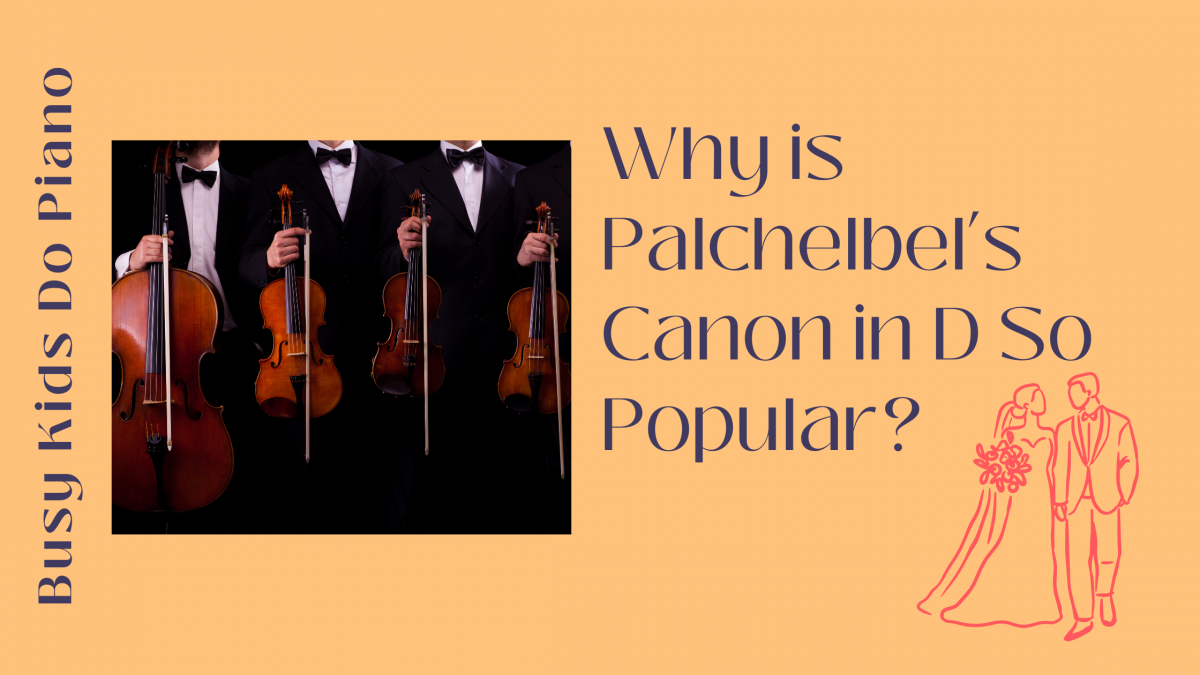
Why Is Pachelbel’s Canon in D Everywhere? The Story Behind the World’s Most Famous Wedding Song
If you’ve been to more than one wedding in your life, I’d put money on the fact that you’ve heard this song. You may not know it by name, but the second those opening notes start, you’ll know exactly what I mean.
It’s Pachelbel’s Canon in D — and it has one of the strangest backstories in classical music. This piece sat in a drawer, essentially forgotten, for almost 300 years. Then it came roaring back and became one of the most recognized pieces of music on the planet. I dug into the whole story for episode 104 of my podcast, Busy Kids Love Music, and I wanted to write it all out here too, because it’s too good not to.
Who Was Johann Pachelbel, Anyway?
Johann Pachelbel was a German Baroque composer — a contemporary and influence on the Bach family, actually (he taught Johann Sebastian Bach’s older brother). He was well-respected in his lifetime, but like a lot of composers from that era, he mostly disappeared from public memory after he died. If you want the fuller story of his life and style, I covered that in episode 103 — this post picks up where that one left off.
What’s wild is that Pachelbel wrote dozens of pieces, and the one everybody knows him for almost didn’t survive at all.
What Is a Musical Canon, Anyway?
Before we get to the “why is this everywhere” part, let’s back up, because the title of the piece is actually a clue.
A musical canon is kind of like a game. In a canon, one melody gets repeated by different instruments (or voices), but each one starts at a different time — so you get this layered, echoing effect where the same tune is chasing itself around. Think of it like a musical round: picture a group of friends singing a song together, where one person starts, and then a few beats later, a second friend jumps in singing that exact same melody from the beginning. Then a third. Everyone’s singing the same thing, just staggered — and somehow it turns into something richer than any one voice singing alone.
You’ve probably sung a canon yourself without knowing the term for it. “Row, Row, Row Your Boat” is a canon. So is “Frère Jacques.” Pachelbel just took that same simple idea and turned it into something genuinely beautiful — three violins, all playing the same melody, entering one after another over a repeating bass line that never stops underneath them.
How a 1968 Recording Rescued a 300-Year-Old Piece
Here’s the part of the story that surprises people most: nobody really knew or cared about this piece for centuries. The oldest surviving copy of the sheet music wasn’t even written down until well over a hundred years after Pachelbel died. It was just… gone. Sitting in obscurity along with most of his other work.
That changed in 1968, when French conductor Jean-François Paillard recorded it with his chamber orchestra. His version was slower and more lush than what Pachelbel probably intended, but it worked — the recording caught on, radio stations started playing it, and by the early 1970s it was everywhere. It showed up in movies. It showed up in commercials. And it became the default song for walking down the aisle, a spot it still hasn’t given up.
(Quick correction from my podcast episode, for anyone who caught it: I mentioned a Neville Marriner recording as the one that sparked the revival — the Paillard recording is actually the one music historians point to. Marriner did record a well-known version of his own later on, but Paillard gets the credit for bringing it back from the dead in the first place. I wanted to set the record straight here!)
Was It Really Written for a Wedding?
Here’s where the story gets a little fuzzy, and I think that’s part of the fun.
Nobody actually knows why Pachelbel wrote this piece, or exactly when. The most credible theory floating around is that he may have composed it for the wedding of Johann Christoph Bach (yes, one of the Bach family) back in 1694 — Pachelbel had taught him as a student, and there’s a record of Pachelbel providing music for that wedding. It’s a nice theory. It’s just never been proven.
What I want to gently clear up: there’s a very different story that circulates online — a much more dramatic (and honestly kind of morbid) tale involving a tragic love story and a proposal song. It’s a compelling story! It also isn’t true. There’s no historical evidence behind it at all — it’s the kind of thing that gets repeated so many times online that people start to believe it’s fact. The real story is quieter than that: an uncertain composition date, a possible wedding connection nobody can confirm, and then three centuries of near-total silence before the piece found its way back to us.
Sometimes the true version of a story is less dramatic than the myth — and I think that’s okay.
Famous Performances Worth Hearing
Since its comeback in the 1970s, Canon in D has been recorded and reinterpreted more times than almost any other piece of classical music. A few performances worth your time if you want to hear it done really well:
- The Berlin Philharmonic, conducted by Herbert von Karajan — full, grand, orchestral
- Itzhak Perlman, whose violin interpretations bring out the emotional depth in that repeating melody
- Yo-Yo Ma, who’s recorded gorgeous cello-forward versions
And of course, there’s my own curated playlist of different interpretations and arrangements — you can find that linked in the original episode’s show notes, if you want to hear how differently this one piece has been played across the decades.
Frequently Asked Questions
Why is Pachelbel’s Canon in D so popular? Its popularity traces back to a 1968 recording by conductor Jean-François Paillard, which got picked up on the radio and turned a nearly-forgotten 17th-century piece into a modern favorite — especially for weddings, where it’s remained a go-to processional song ever since.
Was Canon in D written for a wedding? Possibly. One theory suggests Pachelbel composed it for the 1694 wedding of Johann Christoph Bach, one of his former students, but this has never been confirmed. The exact date and reason for its composition remain unknown.
What is a musical canon? A canon is a piece of music where the same melody is repeated by different voices or instruments, each starting at a staggered time — similar to how “Row, Row, Row Your Boat” works when sung as a round.
Is the tragic love story behind Pachelbel’s Canon true? No. A dramatic story involving a tragic romance and proposal circulates online, but there’s no historical evidence to support it. The real story is simply that the piece’s true origins remain uncertain.
If moments like this — digging into the real story behind a piece of music your kids will actually recognize — sound like your kind of thing, this is exactly what we do inside Busy Kids Do Piano (and if you’re looking to learn something new yourself, Busy Moms Do Piano is there for you too). Music history is one of my favorite parts of what we teach, and there’s a lot more where this came from.
Want to hear this story instead of read it? The original podcast episode is right here.